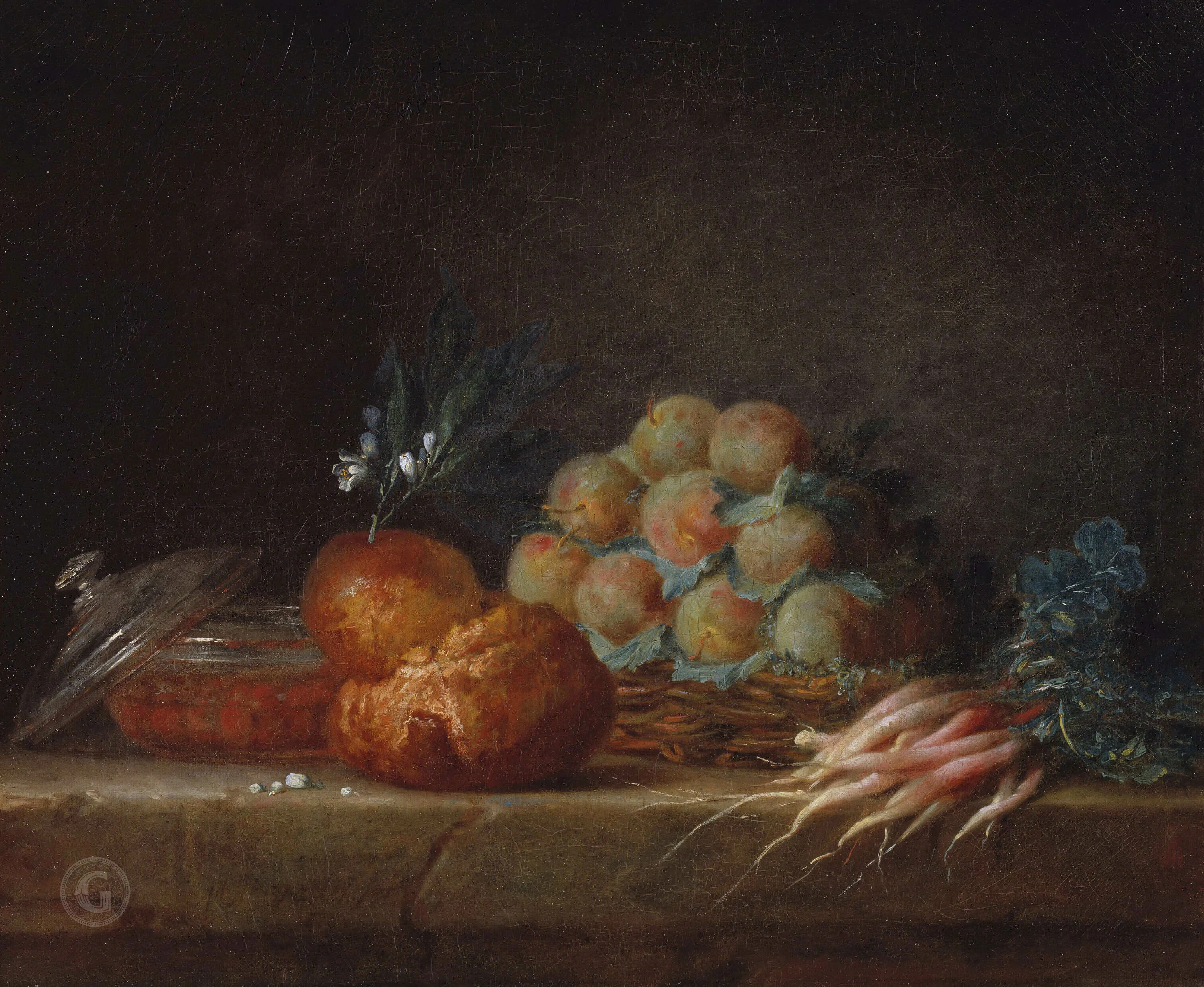
Nature morte avec brioche, fruits et légumes, 1775, Anne Vallayer-Coster, available at the Louvre.
“Let them eat brioche!”
Even though this phrase is wrongly attributed to Marie Antoinette and is better known among our Anglo-Saxon neighbors as “Let them eat cake, ” it reflects just how much of a star brioche was at the time. I’m sure everyone was fighting over it. Oh! That suddenly makes me want to eat some. With jam or as French toast? Hard to choose.
But what did this brioche actually look like?
That’s the question I asked myself after studying several 18th-century lunch and dinner menus. One cake came up often: the Compiègne cake. According to the old recipes, this Compiègne cake resembled a tall brioche, panettone-style, and was made with brioche dough. That struck me as interesting enough to try it out right away, so I got my hands dirty.
I thought it would be quick and easy. Two or three tries, and I’d have the recipe in the bag. After all, I’m a pastry chef and I’ve made thousands of brioches. I know the technique and the steps like the back of my hand.
Except… nothing ever goes as planned. I’ve never messed up a recipe this badly. And I did not mess up just once. Several times. This 18th-century brioche recipe eludes me.
So I took a step back and asked myself: What if 18th-century brioche was different? What if my image of modern brioche and my professional bias created preconceived notions that prevent me from finding the true recipe?
I had to start with a clean slate and begin my search. Let me take you along on my quest to rediscover the authentic 18th-century brioche—or at least my interpretation of it.
Spoiler alert: my quest is still ongoing, and I haven’t yet found the recipe or the magic technique. But I’ve never been this close to success.
Spoiler alert: I still haven’t managed to make this brioche.
A Recipe That Refuses to Turn Out as Expected
For months now, I’ve been experimenting with various 17th and 18th-century recipes, adapting them from cookbooks of that era. Some turned out well on the first try, but even when they weren’t perfect, I could see their potential and understand how to improve them.
That’s not the case with this brioche.
On my first attempt, I started as I usually do with other recipes: I found the old recipe in a collection of cookbooks from the era, transcribed the instructions into modern French, converted the old measurements, and gave it a try.
And that’s when it hit me like a ton of bricks: out of two attempts at two different recipes, neither was edible. One was far, far too salty. In the other, the butter separated from the dough, leaving the result as hard as a brick, perfect for the foundation of my future house. In short, an overwhelming failure.
Compare Sources Before Choosing a Method
I don’t just study one recipe. I found five different recipes from four different authors. These recipes are called brioche or brioche cake. However, even though the names are similar, the proportions, ingredients, and techniques vary.
Comparing these recipes with one another helps you understand the overall approach to making this brioche recipe. That way, you can see what remains consistent and what varies.
Trois des recettes anciennes comparées pendant la recherche. Les annotations en marge correspondent à mes essais de conversion (certains que j’ai revus ensuite car ils sont erronés) et de réduction des quantités.
Let’s weigh the flour… But how much flour do we need?
My very first hurdle in understanding these recipes was converting the old measurements to modern ones.
During the Ancien Régime, every city (and I mean every city) had its own system of measurement. In other words, Versailles didn’t use the same system as Paris. It’s as if today, one gram in Paris were heavier than one gram in Versailles. Same name, not the same mass. So, by extension, a pound (or “Marc’s pound”) from Paris has a different mass than a pound from London or Rome. And of course, these measurements apply only to that period. Thus, a Parisian pound in 1750 is different from the pound currently used in the United States.
The metric system, with its masses in grams and volumes in liters, was introduced after the French Revolution. The measurements that need to be converted in these recipes are quarts of flour, bushels of flour, litrons, ounces, quarterons…
Sidebar: A brief example of my calculations for the amount of flour in the recipe from Menon’s Soupers de la Cour:
- One quart of flour = ¼ of a bushel of flour
- 1 bushel of flour = 13.01 L
- Therefore, 1 quart of flour = 13.01 ÷ 4 = 3.2525 L
However, no one measures flour in liters anymore, so:
- 1 L of flour = approximately 550 g
So for my recipe, I need: 3.2525 × 550 = 1,788.87 g
Therefore, I need a total of 1,788 g of flour.
In short, you get the idea: it takes a lot of conversion, and above all, don’t assume that you know. In fact, when I first started transcribing these recipes, I thought a “quart of flour” was the same as a “quarteron of flour” (i.e., ¼ of a Parisian pound), just another way of saying it. But in reality, they’re not at all the same thing.
One conversion determines everything that follows. If it’s wrong, the entire ratio of butter, liquid, or yeast is thrown off.
“Knead three times… then make three turns, ” or what the recipe actually says
Once the measurements have been converted (assuming they’ve been converted correctly), it’s time to understand the process in general terms. The recipe begins with a quick starter made with brewer’s or baker’s yeast, prepared with flour and a little warm water, but not too much. This starter is then incorporated into a dough rich in butter and eggs. The dough rests and rises for nine to ten hours before being divided, shaped, brushed with egg wash, and baked.
Several details are surprising. First, none of the recipes contain sugar. Brioche is definitely savory, even saltier than bread (23 g of salt per kg for brioche versus 18 g for modern bread).
Second, to make the dough rise, a starter must be created rather than simply adding yeast to the dough. A significant portion of the flour is already present in this pre-fermented dough.
Finally, after the nine to ten hours of rising and fermentation, no final rise (the second rise of the brioche after shaping and before baking, as found in modern recipes) is mentioned.
If the sequence—preparing the dough, allowing it to ferment for nine to ten hours, dividing and shaping it, then glazing and baking—is accurate, then this profoundly changes the dough-making technique compared to a modern recipe.
An intriguing detail: “Wet your hands”
In Lottin de Jeune’s recipe, from his 1772 Portable Dictionary of Cooking, Housekeeping, and Distillation, and in Menon’s The Bourgeois Cookbook, they specify that to shape the brioches, you must wet your hands, not dust them with flour.
At first glance this might seem like a matter of convenience. But this detail becomes much more interesting once I connect it to the consistency I achieved during my tests. The dough is soft and sticky. Adding flour while shaping would alter the texture and would cause localized drying by changing the surface.
Slightly damp hands, on the other hand, allow you to handle the soft dough without adding dry ingredients. They might also result in a smoother, less cracked surface.
From left to right: the crumb structure observed in the dough after nine hours of fermentation and proofing, the shaped dough before baking, and the crumb of the fourth test.
What if I’m looking for the wrong texture?
My first instinct as a contemporary pastry chef was to seek out a highly developed gluten network: a dough that pulls away from the bowl, becomes smooth, and can eventually form that famous texture found in modern brioches. But the more I explored, the less certain I became that it was the right goal.
In the recipes I’m studying, about a third of the flour is already in the sourdough starter. It’s possible that this starter, which has the same texture as dough, adds structure to the dough.
Furthermore, in these old recipes, the butter, salt, remaining flour, and the eggs are mixed together first, and then the sourdough starter is added last. The gluten network therefore cannot form before the butter is incorporated, and prolonged mechanical action may be counterproductive. This action could heat the butter and cause it to separate from the dough.
Thus, I am aiming for a leavened but relatively dense crumb, with irregular air pockets, short fibers, and a rich, tender, and buttery texture. This is not a historically attested texture, but it is the current model to test.
What did brioche look like in the 18th century?
Iconography: or, when paintings complement recipes
Texts alone are not enough to answer this question. They specify the technique but not the visual appearance. The only mention of the shape comes from Menon, in Les Soupers de la Cour, who specifies that they must be flattened before baking.
So I turned to the “Instagram” of the time, aka: painting
I found three 18th-century paintings, all three on display at the Louvre, featuring brioche as their subject.
From left to right: Nature morte avec brioche, fruits et légumes, 1775, Anne Vallayer-Coster. La Brioche, 1763, Chardin, Jean Baptiste Siméon, Pêches et brioches, 1700 / 1800, Anonymous, École de France. All three paintings are on view at the Louvre.
We learn from these paintings that the brioches most likely had a “top, ” just like our modern Parisian brioches. They also appear to have a smooth, golden crust and a soft, fluffy texture. To me, they look so much like our modern brioches that the contrast with my own attempts at making them is striking.
However, just as on Instagram today, painters idealized their subjects. So while we can confirm the general shape, including the presence of the “head”, we cannot confirm the texture, which may very well have been smoothed out to make the painting look prettier.
The crust on my attempt may not be historically inaccurate.
Four attempts, and still no “successful” brioche
The first two attempts resulted in dough that was far too runny. This difficulty even led me to wonder if 18th-century eggs were smaller than ours, since recipes count them by the piece rather than by weight.
I haven’t found a sufficiently reliable source to confirm this, whether in texts, paintings, or engravings. Today, I use the size of a medium egg (53 to 63g) as a working hypothesis rather than as a historical fact. The fact that an attempt using historical proportions with a contemporary baking technique worked better has, in fact, proven to me that egg size is certainly not the main explanation.
In another test, a significant amount of butter leaked out during baking, but I do not consider this a characteristic of historical recipes either. It is a flaw that now requires me to pay closer attention to the temperature during kneading and proofing, and, above all, to the dough’s ability to retain fat.
On the far left, the third attempt. Next, the fourth attempt: a brioche baked whole and cut in half.
As seen in the latest test, the surface is smoother than before. But the profile remains much too flat. When cut, the air pockets are larger and more irregular toward the top, while the lower part remains significantly denser.
At what point is the volume lost?
The problem may arise after the nine- to ten-hour proofing period
The recipes call for a long fermentation of the entire dough, followed by shaping and immediate baking.
Previously, I let the brioche rise wrapped in a floured dish towel. But the dough dried out or stuck completely to the towel. When I peeled it off the towel, it lost all the gas it had built up.
So, to prevent the dough from drying out and sticking, I’m going to use the technique described by Nicolas Bonnefons in Les Délices de la campagne (1665) and shape the brioche directly on the baking sheet. To keep it from drying out, I’ll place it in the turned-off oven with a large container of water to maintain a humid environment.
I hope that after making these adjustments, the dough will retain its honeycomb structure and look more like the paintings.
So, did I finally succeed in making this brioche?
No, and you already knew that because I spoiled the ending for you.
But thanks to this in-depth investigation (which isn’t over yet), I’m starting to understand the techniques and figure out the whys and hows.
I’ve come to realize even more clearly that it’s not enough to simply take an old recipe and adjust the quantities to make it work. Whether it’s the ten hours of fermentation, the absence of sugar, or the lack of a second rise, all these factors are giving me a hard time. When you add in the details—which may not even be details, for that matter—this endeavor becomes all the more difficult.
The paintings added depth to my research and gave me a glimpse of what a brioche from that era might have looked like. So thank you to these three painters—a woman, a man, and an anonymous artist—for deciding, 250 years ago, that painting a brioche was worth doing. It’s been helpful to me; thank you.
Except that now I have more questions than when I started. When do I lose the volume from my first rise? How can I make it rise so it looks a little more like the paintings? How do I bake it perfectly? If I mix and match all the recipes from that era to come up with a technique that works, like a Frankenstein’s brioche, can I still claim to have revived an 18th-century recipe? And most importantly, would Marie Antoinette of Austria have liked my brioche?
While I wait for my 18th-century brioche to come back to life like Frankenstein’s monster, I’m going to make some French toast because this story has made me hungry.